Rabu, 21 Desember 2011

Three Gorges Dam, China

The Three Gorges Dam (simplified Chinesetraditional ChinesepinyinChángjiāng Sānxiá ) is a hydroelectric dam that spans the Yangtze River by the town of Sandouping, located in the Yiling District of Yichang, in Hubei province, China. The Three Gorges Dam is the world’s largest power station in terms of installed capacity (20,300 MW) but is second to Itaipu Dam with regards to the generation of electricity annually.
Three Gorges Dam construction

The dam body was completed in 2006. Except for a ship lift, the originally planned components of the project were completed on October 30, 2008, when the 26th turbine in the shore plant began commercial operation. Each turbine has a capacity of 700 MW. Six additional turbines in the underground power plant are not expected to become fully operational until mid-2011. Coupling the dam's thirty-two main turbines with two smaller generators (50 MW each) to power the plant itself, the total electric generating capacity of the dam will eventually reach 22,500 MW.
As well as producing electricity, the dam increases the Yangtze River's shipping capacity, and reduces the potential for floods downstream by providing flood storage space. The Chinese government regards the project as a historic engineering, social and economic success, with the design of state-of-the-art large turbines, and a move toward limiting greenhouse gas emissions. However, the dam flooded archaeological and cultural sites and displaced some 1.3 million people, and is causing significant ecological changes, including an increased risk of landslides. The dam has been a controversial topic both in China and abroad.

History

A large dam across the Yangtze River was originally envisioned by Sun Yat-sen in The International Development of China, in 1919. He stated that a dam capable of generating 30 million horsepower (22 GW) was possible downstream of the Three Gorges. In 1932, the Nationalist government, led byChiang Kai-shek, began preliminary work on plans in the Three Gorges. In 1939, Japanese military forcesoccupied Yichang and surveyed the area. A design, the Otani plan, was completed for the dam in anticipation of a Japanese victory over China. In 1944, the United States Bureau of Reclamation chief design engineer,John L. Savage, surveyed the area and drew up a dam proposal for the 'Yangtze River Project'. Some 54 Chinese engineers went to the U.S. for training. The original plans called for the dam to use a unique way of moving ships: ships would move into locks located at the lower and top end of the dam. Then cranes with cables with move the ships from one lock to the other. For smaller water craft, dozen would be parked in a landing craft like unit and then lifted by the crane to the next level lock. Whether this solution was considered, because the engineers then considered the height between the river above and below the dam to be to much, or as a water saving concept is unknown.  Some exploration, survey, economic study, and design work was done, but the government, in the midst of the Chinese Civil War, halted work in 1947.

After the 1949 Communist victory, Mao Zedong supported the project, but began the Gezhouba Dam project first, and economic problems including the Great Leap Forward and the Cultural Revolution slowed progress. After the 1954 Yangtze River Floods, in 1956, Mao Zedong authored "Swimming", a poem about his fascination with a dam on the Yangtze River. In 1958, after the Hundred Flowers Campaign, some engineers who spoke out against the project were imprisoned.
During the 1980s, the idea of a dam reemerged. The National People's Congress approved the dam in 1992: out of 2,633 delegates, 1,767 voted in favour, 177 voted against, 664 forfeited, and 25 members did not vote. Construction started on December 14, 1994. The dam was expected to be fully operational in 2009, but additional projects such as the underground power plant with six additional generators are expected to delay full operation until mid-2011. The ship lift is expected to be completed in 2014. The dam had raised the water level to 172.5 m (566 ft) above sea level by the end of 2008 and the maximum level of 175 m (574 ft) by October 2010. 

Minggu, 20 November 2011

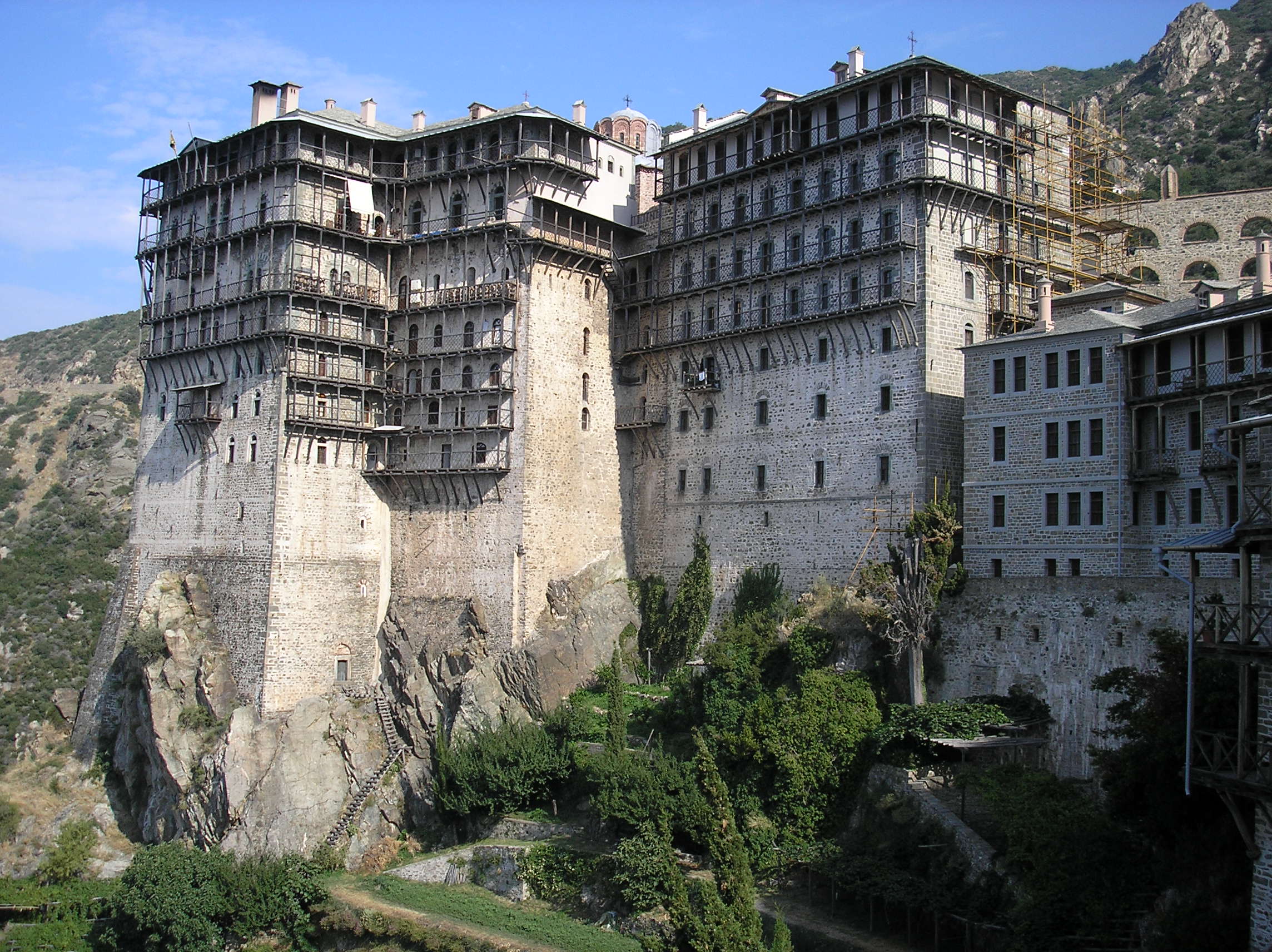
Simonopetra monastery, Mount Athos, Greece

The Holy Monastery of Simonos Petra, or more simply Simonopetra, is without doubt the most daring construction on the Holy Mountain. It stands proudly at a height of 330 metres on the end of a rocky mountain range.


Simonopetra Monastery

The Monastery was founded by the Blessed Simon the Myrrhobletes around 1257, as a result of a vision. The whole of the building work, the Life of the Saint assures us, was accomplished as the result of divine intervention. In 1363 the Monastery was renovated with generous donations from a Serb despot, John Uglesha, who is regarded as the Monastery's second founder. In the Third Typikon, Simonopetra occupies 23rd place among the then monasteries of Athos; today it holds thirteenth place in the hierarchy.

Unfortunately, among the dates which are milestones in the history of the Monastery are those inauspicious days when it was afflicted with the scourge of fire. In 1570 the Monastery, together with its valuable archive, was destroyed by a great conflagration. This resulted in the loss of documents of inestimable historical value. It also explains why we know so little about the Monastery in the Byzantine period.

The good relations which developed between Simonopetra and the Princes of Wallachia in the period of Turkish rule made possible its recovery. However, there was another fire in 1622, causing further damage. Simonopetra, which had been a coenobium, became idiorrythmic in the 17th century. Although never looted by pirates, the intolerable taxes of the Turks drove the Monastery to decline and abandonment. By the heroic efforts of the priest-monk Ioasaph of Mytilene, Asimopetra (as Simonopetra was called in the period of Turkish occupation) began to function again in the late 18th century. The 19th century saw the building of the multi-storeyed building on the south side. At the end of the same century, in 1891, yet another disastrous fire swept away, yet again, the older buildings and the Monastery's treasures.
Simonopetra Monastery Build from Side

In the present century, Simonopetra has experienced a period of recovery and of increasing prestige in the Orthodox world - particularly after the liberation of the Holy Mountain from the Turks and under the enlightened ladership of the Abbots Neophytos, Ioannikios, and Ieronymos. In the 1950s, however, a period of decline set in and in 1963, when Athos celebrated a millennium of life, the prospects for the future were gloomy. But the 1970s were a time when there was a gradual revival of Athonite monasticism. In 1973 a new 20-member brotherhood from the Meteora established itself at the Monastery. The Monastery of Simonos Petra once had a large number of metochia with fertile farm land. The oldest of these would appear to be Petriotiko in Sithonia. Today, best known are St Charalampus in Thessaloniki, the Ascension in Athens, the Nunnery of the Annunciation at Ormylia in Chalcidice, and three others in France. It is also worth mentioning the metochi of Michael Voda in Bucharest, dedicated to the Monastery in 1566 and confiscated by the Romanian Government in 1863.

Simonopetra, because of the restricted space of its site, is not one of those monasteries where we can see autonomous, clearly distinguished buildings. The katholikon is dedicated to the Nativity of Christ and in its original form was built around 1600, while the form it takes today took shape after the fire of 1891. The Monastery has four chapels within its precinct and eight outside.

The Monastery's archive contains a host of documents in Greek, Turkish, and Romanian, together with inscriptions, and musical and other manuscripts, to which must be added its printed books. However, it must be pointed out that almost the whole of the archival material is post-Byzantine.

The sacristy contains a treasury of works of art, consisting of icons, vestments, silverware, antimensia, seals, and engravings. However, the most important treasure of Simonopetra is the left hand of St Mary Magdalene - she is regarded as 'co-founder' of the Monastery - which has remained whole for two thousand years. The Monastery today has a community of 50 well-educated and active monks.


Minggu, 10 Juli 2011

Alat Respirasi Hewan

1. Alat Respirasi pada Serangga

Corong hawa (trakea) adalah alat pernapasan yang dimiliki oleh serangga dan arthropoda lainnya. Pembuluh trakea bermuara pada lubang kecil yang ada di kerangka luar (eksoskeleton) yang disebut spirakel. Spirakel berbentuk pembuluh silindris yang berlapis zat kitin, dan terletak berpasangan pada setiap segmen tubuh. Spirakelmen punyai katup yang dikontrol oleh otot sehingga membuka dan menutupnya spirakel terjadi secara teratur. Pada umumnya spirakel terbuka selama serangga terbang, dan tertutup saat serangga beristirahat.

 
Gbr. Trakea pada serangga

Oksigen dari luar masuk lewat spirakel. Kemudian udara dari spirakel menuju pembuluh-pembuluh trakea dan selanjutnya pembuluh trakea bercabang lagi menjadi cabang halus yang disebut trakeolus sehingga dapat mencapai seluruh jaringan dan alat tubuh bagian dalam. Trakeolus tidak berlapis kitin, berisi cairan, dan dibentuk oleh sel yang disebut trakeoblas. Pertukaran gas terjadi antara trakeolus dengan sel-sel tubuh. Trakeolus ini mempunyai fungsi yang sama dengan kapiler pada sistem pengangkutan (transportasi) pada vertebrata.

Mekanisme pernapasan pada serangga, misalnya belalang, adalah sebagai berikut :
Jika otot perut belalang berkontraksi maka trakea mexrupih sehingga udara kaya COZ keluar. Sebaliknya, jika otot perut belalang berelaksasi maka trakea kembali pada volume semula sehingga tekanan udara menjadi lebih kecil dibandingkan tekanan di luar sebagai akibatnya udara di luar yang kaya O2 masuk ke trakea.

Sistem trakea berfungsi mengangkut OZ dan mengedarkannya ke seluruh tubuh, dan sebaliknya mengangkut CO2 basil respirasi untuk dikeluarkan dari tubuh. Dengan demikian, darah pada serangga hanya berfungsi mengangkut sari makanan dan bukan untuk mengangkut gas pernapasan.
Di bagian ujung trakeolus terdapat cairan sehingga udara mudah berdifusi ke jaringan. Pada serangga air seperti jentik nyamuk udara diperoleh dengan menjulurkan tabung pernapasan ke perxnukaan air untuk mengambil udara.

Serangga air tertentu mempunyai gelembung udara sehingga dapat menyelam di air dalam waktu lama. Misalnya, kepik Notonecta sp. mempunyai gelembung udara di organ yang menyerupai rambut pada permukaan ventral. Selama menyelam, O2 dalam gelembung dipindahkan melalui sistem trakea ke sel-sel pernapasan.

Selain itu, ada pula serangga yang mempunyai insang trakea yang berfungsi menyerap udara dari air, atau pengambilan udara melalui cabang-cabang halus serupa insang. Selanjutnya dari cabang halus ini oksigen diedarkan melalui pembuluh trakea.

2. Alat Pernapasan pada Kalajengking dan Laba-laba

Kalajengking dan laba-laba besar (Arachnida) yang hidup di darat memiliki alat pernapasan berupa paru-paru buku, sedangkan jika hidup di air bernapas dengan insang buku. Paru-paru buku memiliki gulungan yang berasal dari invaginasi perut. Masing-masing paru-paru buku ini memiliki lembaran-lembaran tipis (lamela) yang tersusun berjajar. Paruparu buku ini juga memiliki spirakel tempat masuknya oksigen dari luar. Keluar masuknya udara disebabkan oleh gerakan otot yang terjadi secara teratur.

 
Gbr. Irisan melintang paru-paru buku pada laba-laba
                          
Baik insang buku maupun paru-paru buku keduanya mempunyai fungsi yang sama seperti fungsi paru-paru pada vertebrata.

3. Alat Pernapasan pada Ikan

Insang dimiliki oleh jenis ikan (pisces). Insang berbentuk lembaran-lembaran tipis berwarna merah muda dan selalu lembap. Bagian terluar dare insang berhubungan dengan air, sedangkan bagian dalam berhubungan erat dengan kapiler-kapiler darah. Tiap lembaran insang terdiri dare sepasang filamen, dan tiap filamen mengandung banyak lapisan tipis (lamela). Pada filamen terdapat pembuluh darah yang memiliki banyak kapiler sehingga memungkinkan O2 berdifusi masuk dan CO2 berdifusi keluar. Insang pada ikan bertulang sejati ditutupi oleh tutup insang yang disebut operkulum, sedangkan insang pada ikan bertulang rawan tidak ditutupi oleh operkulum. 


Insang tidak saja berfungsi sebagai alat pernapasan tetapi dapat pula berfungsi sebagai alat ekskresi garam-garam, penyaring makanan, alat pertukaran ion, dan osmoregulator. Beberapa jenis ikan mempunyai labirin yang merupakan perluasan ke atas dari insang dan membentuk lipatan-lipatan sehingga merupakan rongga-rongga tidak teratur. Labirin ini berfungsi menyimpan cadangan O2 sehingga ikan tahan pada kondisi yang kekurangan O2. Contoh ikan yang mempunyai labirin adalah: ikan gabus dan ikan lele. Untuk menyimpan cadangan O2, selain dengan labirin, ikan mempunyai gelembung renang yang terletak di dekat punggung.

Mekanisme pernapasan pada ikan melalui 2 tahap, yakni inspirasi dan ekspirasi. Pada fase inspirasi, O2 dari air masuk ke dalam insang kemudian O2 diikat oleh kapiler darah untuk dibawa ke jaringan-jaringan yang membutuhkan. Sebaliknya pada fase ekspirasi, CO2 yang dibawa oleh darah dari jaringan akan bermuara ke insang dan dari insang diekskresikan keluar tubuh.

Osmoregulasi :
Osmoregulasi pada ikan adalah pengaturan tekanan cairan tubuh yang layak bagi kehidupan ikan.


Selain dimiliki oleh ikan, insang juga dimiliki oleh katak pada fase berudu, yaitu insang luar. Hewan yang memiliki insang luar sepanjang hidupnya adalah salamander.

You can replace this text by going to "Layout" and then "Page Elements" section. Edit " About "

3D Cube


Powered By Blogger